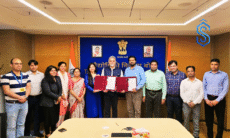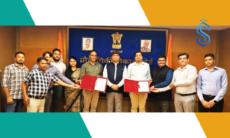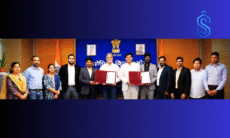

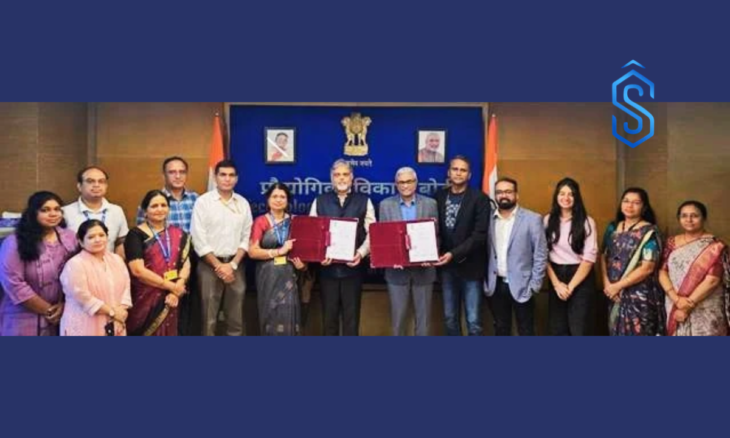
New Delhi: The Technology Development Board (TDB), Department of Science & Technology (DST), Government of India, has signed an agreement with Bengaluru-based QNu Labs Private Limited for ₹150 crore in financial support under the Research Development and Innovation (RDI) Fund to strengthen India’s indigenous quantum-secure technology ecosystem.
The project has a total cost of ₹300 crore and aims to develop an indigenous technology backbone for India’s Quantum Secure and Sensing Networks (IQSN).
Under the agreement, the programme will advance a portfolio of technologies from Technology Readiness Levels (TRL) 4–5 towards TRL-9.
The initiative will support the development, integration and validation of a sovereign quantum-security and sensing technology stack. The financial support will be provided through Optionally Convertible Debt (OCD).
The initiative is aimed at strengthening India’s quantum-secure technology ecosystem across cybersecurity, communications, navigation and precision timing.
As digital infrastructure becomes increasingly interconnected, securing device authenticity, navigation systems, time synchronisation and communications has emerged as a critical technological priority.
Quantum technologies offer new approaches to these challenges, particularly in applications where conventional security mechanisms may face limitations from evolving cyber and technological threats.
QNu Labs’ proposed programme will address these requirements through an integrated framework built around four pillars: identity security, location integrity, network security and time integrity.
The programme brings together complementary capabilities to establish a unified foundation for sovereign security and sensing infrastructure, supporting India’s quantum-secure technology ecosystem.
- Identity Security
Under the identity security pillar, the programme envisages quantum-secure physical unclonable functions (PUFs) and quantum-safe trusted platform modules (TPMs).
These technologies are intended to support hardware-based device identity, authentication and cryptographic security.
The technologies are also intended to strengthen trust at the device level and reduce vulnerabilities associated with compromised or replicated identities.
This component forms a key part of the proposed quantum-secure technology ecosystem, with security capabilities being developed at the hardware level.
- Location Integrity
The location integrity pillar will focus on technologies designed to support trusted navigation and detect attempts to manipulate or spoof positioning systems.
The proposed work includes compact quantum magnetometers for electromagnetic tampering detection and GPS-denied navigation capabilities.
These technologies could support defence and other mission-critical platforms as part of the broader quantum-secure technology ecosystem being developed under the programme.
- Network Security
Under the network security pillar, the programme seeks to advance a quantum-secure communications ecosystem through chip-based quantum key distribution (QKD), satellite-based QKD and supporting technologies.
These include quantum-secure communication modules and encryption systems. The objective is to develop deployable capabilities for secure communications across terrestrial and long-distance networks.
The development of chip-based and satellite-based QKD is expected to form an important component of India’s quantum-secure technology ecosystem, with the programme focused on advancing technologies towards higher readiness and deployment.
- Time Integrity
The fourth pillar, time integrity, focuses on indigenous high-precision timing infrastructure. This includes atomic clock technology and secure time synchronisation using QKD-authenticated distribution.
Reliable and tamper-resistant time synchronisation is essential for telecommunications, financial systems, critical infrastructure and defence applications.
The time integrity component will therefore contribute to the broader quantum-secure technology ecosystem by addressing secure and reliable timing infrastructure.
Together, the four pillars are intended to contribute to an integrated quantum trust framework supporting device authenticity, secure communications, trusted navigation and tamper-resistant timing.
The programme will involve further research, engineering refinement, system integration and validation to progress the technologies towards higher levels of readiness and deployment.
Rajesh Kumar Pathak, Secretary, TDB, said: “Quantum technologies are opening new possibilities for addressing complex challenges in cybersecurity, communications, navigation and critical infrastructure.
Building indigenous capabilities across these interconnected domains is important for strengthening India’s technological self-reliance and long-term security.
Through the RDI Fund, TDB is supporting the development and maturation of advanced technologies that require sustained investment to progress from research and engineering to integrated, deployable systems.”
The ₹150 crore support to QNu Labs under the RDI Fund is aimed at accelerating the development of technologies that can contribute to India’s quantum-secure technology ecosystem and sovereign quantum-security and sensing capabilities.
The Founder of QNu Labs Private Limited said: “Quantum technologies will shape how nations protect their communications, devices, navigation and timing systems.
TDB’s support under the RDI Fund allows us to accelerate our R&D roadmap beyond quantum security stack.
Our work will focus on four connected areas: device identity, location integrity, network security and time integrity, so that trust is built into infrastructure from the hardware upwards.
“This programme extends quantum security foundation into chip-based and satellite-based QKD, quantum sensing and AI.
We see this partnership as a responsibility: to deliver indigenous capabilities that India’s defence, telecom, financial and critical infrastructure sectors can rely on, and to strengthen the wider quantum ecosystem through collaboration with academia, startups and industry.”
The partnership between TDB-DST and QNu Labs is focused on advancing technologies from TRL 4–5 to TRL-9 while developing an integrated quantum-secure technology ecosystem spanning identity security, location integrity, network security and time integrity.
Also Read: Panacea Medical Technologies to Develop Indigenous 32-Slice CT Scanner